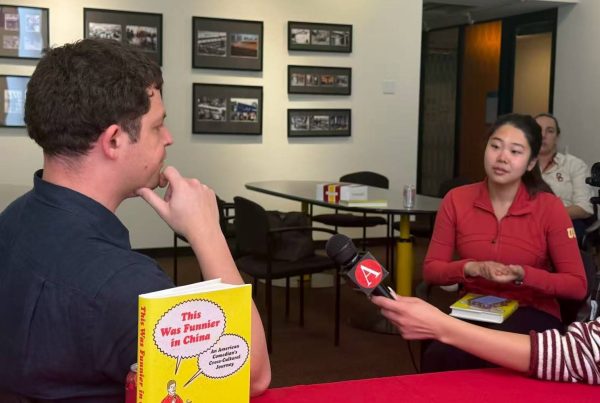
John Van Fleet is a China-based educator and researcher with more than two decades of experience working in Chinese higher education and executive education. He’s currently an adjunct faculty member at Shanghai Jiao Tong University’s Antai College of Economics and Management, and has held senior academic leadership roles, including founding assistant dean of the USC Marshall–SJTU Global Executive MBA program in Shanghai. His current work, First Time in History, centers on the Golden Triangle project, which examines the convergence of renewable energy, autonomous mobility, and smart cities in China. Van Fleet argues that these three forces are mutually reinforcing and already reshaping urban life, economic growth, and technological leadership.
What first led you to focus on renewable energy, autonomous mobility, and smart cities, which is known as the “golden triangle” concept, and why do you see these three areas as fundamentally interconnected?
I started getting the feeling that something really profound was happening in China that my country (the United States) didn’t fully recognize. I moved to Shanghai in 2001. Before that, I lived in Japan for 10 years, and I was traveling to China a lot for business in the 1990s. I just kept thinking something really powerful is happening, and people back home don’t really know.
I started working on this thing I call First Time in History. Less than a year ago, I was teaching an Executive MBA class in Chengdu. It was a class of Chinese students, most of them don’t speak English. Suddenly, I realized that this piece fits with this piece, and this piece fits with this piece.
Everybody talks about renewable energy. Everybody talks about autonomous vehicles. But they talk about them separately. I don’t think it’s unique, but I haven’t seen anybody else actually talking about the Golden Triangle. I guess I just got lucky. I’m usually pretty good at assembling things.
Based on your long experience living and working across cultures, have you observed any significant shifts in how Chinese and Americans perceive one another?
I think most people would agree that the 2008 global financial crisis was a paradigm shift for people in China. Before that, it was quite common for people to sort of worship the West and think everything over there is really cool and that China needed to learn how to be more like them.
Then the economy blew up because of stupid greed and financial mismanagement. A lot of people in China started thinking maybe these people don’t quite know everything.
On the U.S. side, my own country and culture are famously not very international and pretty arrogant. We think we’re the greatest in the world. There’s a whole category called American exceptionalism. I have the sense that a lot of the hostility we see toward China now comes from envy. People see what’s happening over there, how fast it’s developing, and they just can’t get their heads around the idea that another country could be a world leader. The more China grows, the uglier this is going to get.
In your framework, you emphasize market scale, government coordination, and consumer adoption. Which of these is most underestimated by outside observers?
All of them.
For autonomous mobility, you need three things: a large enough market to attract the private sector, sufficient and appropriate government engagement, and a population that is digitally engaged. China leads the world in all three.
Most people in the United States still think China is entirely controlled by the Communist Party and that Xi Jinping dictates how much toilet paper you buy every week, which is absurd. We have no clue how much of China is a market economy. The data is very clear: 60 percent of GDP, 70 percent of employment, 80 percent of profit. It’s huge.
Second, in the United States, we have a large faction that thinks the government is just bad, full stop. They look at China giving subsidies, building infrastructure, passing laws, and they think that’s evil. They don’t understand the value of government coordination.
Third, digital engagement is a double-edged sword. Chinese people are willing to be digitally engaged because they know they have no privacy. That wouldn’t fly in the U.S. Societies that can get the balance right between engagement and protection will lead the future, but nobody has done it right. It’s messy, ugly, and it will take decades.
Looking ahead, what developments within this “Golden Triangle” do you personally find most compelling or meaningful? Do you think the United States is prepared for the transition?
All of it is interesting. Renewable energy is visible in places like Gansu with the wind turbines. Smart cities and autonomous vehicles are things you can actually see working.
But what I really want to see isn’t the tech. I want to see a whole lot of people your age getting smart and changing this country so that it understands the power of this and helps our own society get better. That’s what I’d really like to see.
The United States will be one of the last countries to make this transition. You have to have a whole lot of people my age and maybe your parents’ age die. We have a cultural concept built up over centuries that worked for the 19th and 20th centuries but is not fit for the 21st and 22nd.
Is there anything you feel is often missing from public conversations about U.S.–China relations that you’d like to emphasize?
I would like millions of people from China and millions of people from the United States to engage with each other and ignore the government. Most of what matters in our lives isn’t the government. It’s earning money, feeding families, and sending kids to school.
We spend vastly too much time talking about governments and not nearly enough time knowing people. I want Americans to go to China and forget the image of Mao jackets and red armbands. I want Chinese people to come here and realize we’re not all Donald Trump.
Another thing I want people to do is grow up. As Yuval Noah Harari says, most information is junk. If we’re going to be digitally mature citizens in the 21st century, we have to get smarter about the digital environment.